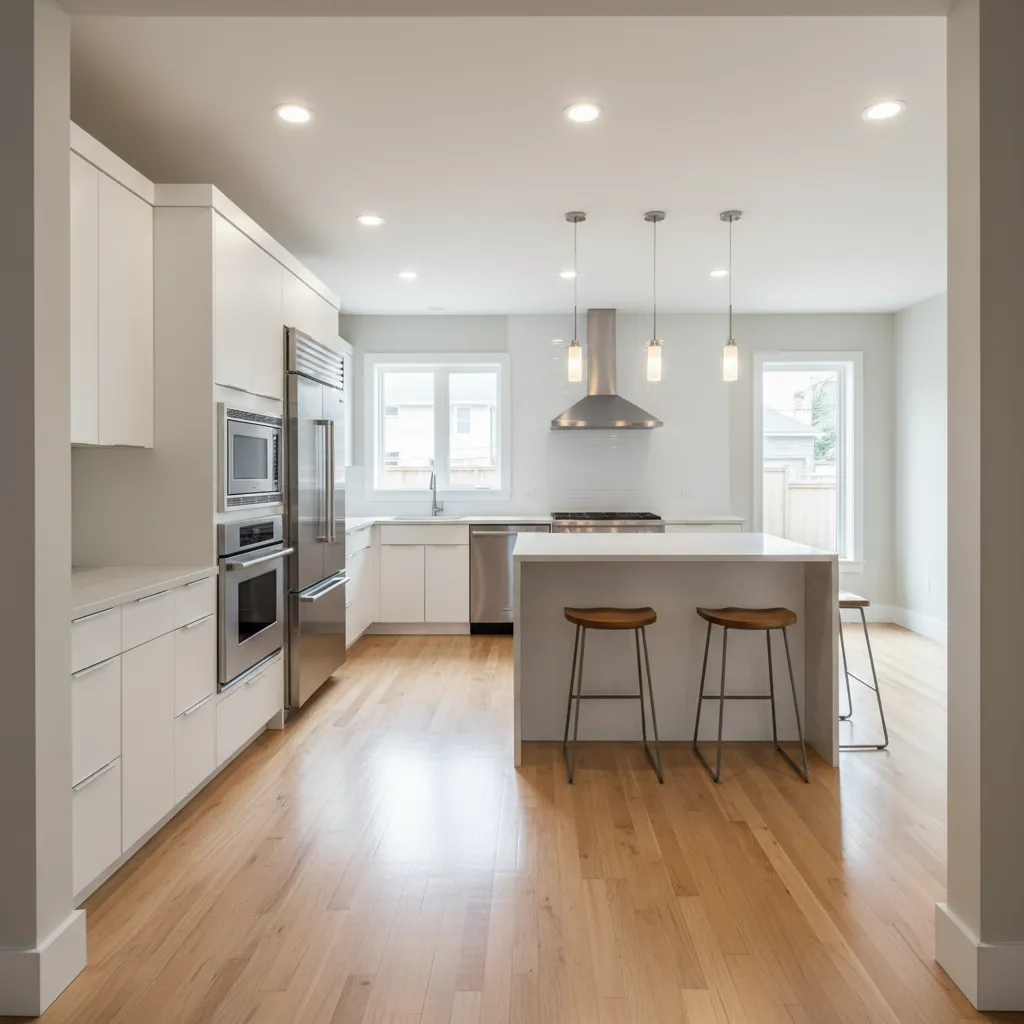
Kitchen Renovations: What the Data Says About Buyer Appeal
Learn how kitchen condition and updates affect buyer perception and home value. Data-driven insights on renovation ROI and buyer preferences.
Kitchen Renovations: What the Data Says About Buyer Appeal
The kitchen is the first thing most homebuyers consider when evaluating a property. It's also the most expensive room to renovate. So the question every seller asks is: "Should I renovate my kitchen before selling?"
The answer depends on several factors. This guide breaks down what the research shows about kitchens, buyer behavior, and how to make the right decision for your situation.
1. Why Kitchens Matter to Buyers
Kitchens are where families spend time. They're also where realtors know buyers judge the overall condition of a home.
What Buyers Evaluate
- Appliances (age, brand, condition, stainless steel vs. older finishes)
- Countertops (quartz/granite vs. laminate, wear patterns)
- Cabinets (custom vs. builder-grade, finish quality, functionality)
- Flooring (hardwood, tile, laminate, stains/wear)
- Layout (modern open concept vs. galley kitchen)
- Lighting (natural light, good fixtures)
- Plumbing (single vs. double sink, water pressure)
- Overall design (modern/updated vs. dated style)
A buyer in a 2-hour home tour may spend 20 minutes in the kitchen. If that 20 minutes feels outdated or poorly maintained, it colors their perception of the entire home.
2. How Kitchen Condition Maps to Home Value
Real estate professionals and appraisers use a standardized condition scale (C1-C6) to grade properties. Kitchen condition is one of the biggest drivers of overall value.
C1-C2 Kitchens (Excellent to Very Good)
- New or recently fully renovated
- High-end finishes (quartz/granite, custom cabinets, stainless steel)
- Modern design, excellent layout
- Buyer reaction: "This is move-in ready"
- Market position: Commands premium pricing, faster sale
C3 Kitchen (Good)
- Well-maintained, 5-15 years old
- Standard finishes (solid counters, decent cabinets)
- Functional layout, minor wear
- Buyer reaction: "It's nice, maybe I'd refresh the backsplash"
- Market position: Neutral, represents market average pricing
C4 Kitchen (Fair to Adequate)
- 15-25 years old, deferred maintenance
- Worn countertops, older appliances, visible wear
- Functional but dated, may need cosmetic updates
- Buyer reaction: "This will need work" or "I'd renovate this"
- Market position: Below-market pricing to account for needed updates
C5-C6 Kitchen (Poor to Very Poor)
- 25+ years old, significant issues
- Broken appliances, damaged counters, layout problems
- May have safety or functionality concerns
- Buyer reaction: "I'm pricing this assuming a full renovation"
- Market position: Deep discount
3. The Renovation ROI Question: What Does the Data Show?
Here's what industry research tells us about kitchen renovations:
Major Kitchen Renovation ($30K-$100K+)
- Homeowner cost: Significant (often $50-100K+ depending on scope)
- Buyer perception: Highly positive ("Wow, the kitchen is beautiful")
- Impact on buyer appeal: High (kitchen is the first thing buyers notice)
- Impact on speed of sale: Faster sales and more offers typically observed with updated kitchens
- Industry benchmarks: Typical outcomes show buyers respond favorably to modern kitchens
Industry research suggests: Properties with updated kitchens tend to receive more buyer interest and may sell more quickly than comparable homes with dated kitchens. However, the financial return varies significantly by market, neighborhood, and existing home value.
Minor Kitchen Updates ($5K-$15K)
- Examples: Paint, new hardware, backsplash, new lighting
- Buyer perception: "Modest but thoughtful updates"
- Impact: Incremental positive, removes obvious worn appearance
- Industry benchmarks: Even small updates can improve buyer perception
Industry research suggests: Properties that appear well-maintained and clean (fresh paint, clean appliances, tidy counters) typically receive more showings than properties that appear neglected, even if finishes aren't new.
Cosmetic Fixes (~$1K-$3K)
- Examples: Professional cleaning, fresh paint, minor hardware updates, new backsplash
- Buyer perception: "Cared for and clean"
- Impact: Removes "neglected" appearance, disproportionately high value per dollar
- Industry research: Cleanliness and basic freshness are surprisingly high-impact on buyer impressions
4. Should You Renovate Before Selling? The Decision Tree
Renovate If:
- Your kitchen is in C4 condition or lower (visibly dated/worn)
- Your home price point is $400K+ (high-end buyers expect updated kitchens)
- You have time before selling (3-6 months to plan/execute)
- Your neighborhood shows strong kitchen updates (realtors confirm trend)
- Your market is competitive (sellers with upgraded kitchens winning listings)
Just Paint & Stage If:
- Your kitchen is C3 condition (well-maintained, modern layout)
- It's functionally updated but cosmetically tired (good bones, tired finishes)
- You have limited budget (better ROI on staging than full reno)
- Your market is soft (fewer buyers competing, less pressure)
Don't Renovate If:
- Your kitchen is already C2 condition (excellent, recently updated)
- You're price-constrained ($200K home, $30K kitchen reno may not return fully)
- You're time-constrained (renos take 4-8 weeks minimum)
- The market favors buyers (inventory high, prices softening)
5. The Staging Alternative: What Can Paint + Presentation Do?
You don't always need a full renovation to improve buyer perception.
High-Impact, Low-Cost Kitchen Updates
- Deep cleaning ($200-500, professional service)
- Fresh paint ($1K-2K, neutral colors)
- New cabinet hardware ($300-800, instant refresh)
- Backsplash upgrade ($2K-5K, modern look)
- Lighting improvements ($500-2K, better ambiance)
- New faucet ($500-1,500, updated look)
- Professional staging ($1K-3K, better presentation)
Industry research: Properties that are clean, well-lit, and freshly painted are often perceived as being in better condition than homes with worn countertops and dated finishes, even if the underlying condition is similar.
Staging Strategy for Kitchens
- Clear countertops (minimal decor, remove clutter)
- Neutral dishes/bowls visible (suggests space and organization)
- Bright lighting (turn on all lights during showings)
- Fresh flowers or bowl of fruit (homey, not staged-looking)
- Consistent design (coordinate with dining/living room aesthetic)
- Open concept emphasis (remove visual barriers)
6. Renovation Timing: When Does It Make Sense?
Pre-Listing Renovation
If doing: Plan 8-12 weeks before targeting listing date
- Allows time for permits, construction, punch-list
- Home shows well in professional photos
- Fewer buyer concerns about ongoing work
- More confident pricing
During-Listing Negotiation
Caution: Shows often slow when homes are under renovation
- Some buyers avoid active construction
- Staging becomes harder
- Timeline uncertainty concerns buyers
- Generally not recommended unless reno is essential
7. The Curb-to-Kitchen Impact
While the kitchen is crucial, don't neglect the overall home.
Buyers Evaluate in Order:
- Curb appeal (outside appearance, landscaping)
- Entry hallway (first impression stepping inside)
- Kitchen (heart of the home, major assessment point)
- Bathrooms (second assessment point)
- Bedrooms/living spaces (size, light, layout)
Industry insight: A home with a mediocre kitchen but excellent curb appeal and clean bathrooms often outperforms a home with a beautiful kitchen but neglected exterior.
8. Kitchen Renovation Case Studies: What Works
Scenario A: 30-Year-Old Kitchen in $500K Home
- Before: Original cabinets, laminate counter, 1985 appliances
- Typical approach: Full renovation ($50-70K)
- Market outcome: Renovation typically results in significantly improved buyer interest
- Pricing strategy: Price reflects updated kitchen value
Scenario B: 15-Year-Old Kitchen in $400K Home
- Before: Builder-grade cabinets, granite counter, dated appliances
- Typical approach: Hardware refresh + paint + new appliances ($15-20K)
- Market outcome: Incremental improvement in buyer perception, faster sale
- Pricing strategy: Minor premium for updates
Scenario C: Brand-New Kitchen in $300K Home
- Before: Already modern (5 years old, good condition)
- Typical approach: No renovation needed, focus on staging/curb appeal
- Market outcome: Kitchen is competitive advantage, not improvement area
- Pricing strategy: Full market pricing, not discounted
9. The Financial Question: What's Your Budget?
Budget Decision Framework
- Under $500K home, $20K kitchen budget: ROI typically positive (removes dated appearance)
- Under $500K home, $50K kitchen budget: ROI depends on market (may not fully recover)
- $500K+ home, $50K kitchen budget: ROI typically strong (expected feature)
- $500K+ home, $100K+ kitchen budget: Research local market (make sure it aligns with neighborhood)
Key insight: The financial return of a renovation depends less on the amount spent and more on whether the investment brings the home in line with market expectations for its price and neighborhood.
Spending $50K on a kitchen in a neighborhood where $300K homes have $20K kitchens may not deliver proportional value.
10. Getting Professional Input
Before deciding, talk to:
Your Realtor
- Ask: "Do kitchens in my price range in this neighborhood have updated kitchens?"
- Ask: "What kitchen improvements have you seen correlate with faster sales?"
- Ask: "What condition is my kitchen compared to recent comp sales?"
A Kitchen Designer/Contractor
- Get quotes for scenarios (cosmetic vs. mid-range vs. full)
- Understand timeline and disruption
- Identify absolute-must-do items vs. nice-to-have
Your Home Appraiser (if you already have one)
- Ask: "What kitchen improvements would be most impactful for this home's value?"
Make Your Decision
The kitchen renovation decision comes down to:
- Your kitchen's current condition (C1-C6 assessment)
- Your home's price point (market expectations)
- Your timeline (can you wait, or must you sell soon?)
- Your budget (and expected return)
- Your market (competitive, balanced, or buyer-favored?)
In most cases, removing dated appearance through strategic updates is more cost-effective than a complete renovation. Clean, well-maintained, and moderately updated kitchens appeal to buyers more than deteriorated kitchens, regardless of price point.
When in doubt, consult your realtor. They know your specific market and can advise on what's likely to move your home fastest and at the strongest price.
Disclaimer: This is general information for educational purposes only. Industry benchmarks about kitchen renovations are directional and vary significantly by market, neighborhood, home price, and individual factors. Actual return on renovation investment depends on numerous variables including local market conditions, the specific renovations chosen, quality of execution, and overall market demand.
Do not rely on this information for specific financial or investment decisions. Individual outcomes vary. Consult a licensed realtor familiar with your local market, a professional appraiser, or a real estate financial advisor for personalized guidance. Hausprice provides general insights only and does not guarantee renovation returns or home value impacts.
Back up your pricing recommendation with data.
Generate a professional, client-ready report in 3 minutes — AI photo analysis, comps, and condition assessment included.
Generate a Report